Drag and drop (react-native-gtkx/dnd)
A mirror of
react-native-reanimated-dnd's
API, implemented on GtkDragSource/GtkDropTarget — native GTK
drag-and-drop rather than a gesture animated by JavaScript. Both the
react-native-gtkx/metro and react-native-gtkx/vite presets alias the bare
react-native-reanimated-dnd package name onto this subpath automatically,
exactly as they do react-native-svg (see svg.md), so an app that
already does drag-and-drop keeps its source unchanged:
import { Draggable, Droppable, DropProvider } from "react-native-reanimated-dnd"
A ported app's one other import, <GestureHandlerRootView> — present
because upstream's quick start puts it at the root — is covered too:
react-native-gesture-handler is aliased to
react-native-gtkx/gesture-handler, a shim that
implements that root faithfully and makes every other RNGH export throw
where it is used.
Why a mirror, not the library
react-native-reanimated-dnd cannot run on this platform as published.
Reanimated 4, react-native-worklets and react-native-gesture-handler are
imported at module scope in twelve of its files, its sort algorithm lives
inside a useAnimatedReaction worklet, its row layout inside a
useAnimatedStyle, and its public types are written in SharedValue<T>.
This subpath re-implements the same API surface as plain functions and
components over real GTK widgets instead.
Opting out of the mirror
Once the gesture-handler and Reanimated-compatible surfaces exist as their
own shims, the real react-native-reanimated-dnd package can run on top of
them unmodified. An app can choose that instead of the mirror with a bundler
alias override (aliases: { "react-native-reanimated-dnd": false }), which
falls through to upstream's own implementation. See
reanimated-compat.md for what the Reanimated surface
underneath it provides.
One drag-and-drop API, two shapes
- Porting an app that already uses
react-native-reanimated-dnd— nothing changes. Both presets alias the package name; the imports stay as they are. - Writing a new app — import from
react-native-gtkx/dnddirectly. Same names, same props, so the code reads correctly to anyone who knows the library. - Reordering by row id rather than by array index — a
Droppablearound aDraggableper row, inside oneDropProvider, is the right shape when a store owns the order, filters it and sorts it.Sortableowns an array and reports positions, which fits when the component itself owns the order.
List/ListRow are not part of react-native-gtkx/common's export
surface — that would have been Adwaita's list appearance written in React
Native, an app's own concern, with its own id-keyed reorder bundled in. An
app that wants id-keyed reordering combines Droppable and Draggable per
row instead, as above. See
Overview
for what react-native-gtkx/common does and does not carry.
The exported surface
DropProvider— Scopes a set of draggables and droppables. Renders aView— upstream renders a fragment — becauseonDraggingneeds a widget to attach to. ItsrefgivesgetDroppedItems()andrequestPositionUpdate().Draggable,DraggableHandle,useDraggable— The drag source. With a handle, theGtkDragSourceattaches to the handle's widget only, so the rest of the item stays pressable.Droppable,useDroppable— The drop target.capacityis enforced in GDK's::accept, so a full zone shows the no-drop cursor.Sortable,SortableItem,useSortable,useSortableList,useHorizontalSortable,useHorizontalSortableList— Drag-to-reorder, vertical by default or horizontal (direction="horizontal"). The component owns the order — upstream's own contract — read the settled one fromonDrop'sallPositions.SortableGrid,SortableGridItem,useGridSortable,useGridSortableList— The 2-D sibling: cells reorder the same way, in a real YogaflexWrapgrid rather than upstream's absolutely-positioned cells. There is no list-levelonMove/onDragStart/onDrop/onDragginghere, matching upstream's ownSortableGridProps— wire those on eachSortableGridIteminstead.DraggableState,ScrollDirection,SortableDirection,HorizontalScrollDirection,GridOrientation,GridStrategy,GridScrollDirection— The enums, unchanged from upstream.clamp,listToObject,objectMove— The list-order utilities, as plain functions rather than worklets.calculateGridPosition,calculateIndexFromRowColumn,listToGridObject,getGridCellFromCoordinates,reorderGridInsert,reorderGridSwap,calculateGridContentDimensions,findItemIdAtIndex— The grid utilities, same reasoning: plain functions, not worklets.getGridCellFromCoordinatesfloors onto the cell whose top-left corner is at or before the point, exactly matching upstream's own behavior.SharedValueLike<T>— WhatSharedValue<T>degrades to:{ value: T }, without the worklet crossing. Reads and writes work; they just do not animate.
Deliberately not re-exported: setPosition, setAutoScroll,
setGridPosition, setGridAutoScroll. Upstream exports these as worklet
helpers that mutate a SharedValue mid-gesture, driven by a UI-thread
gesture that does not exist here — there is nothing for them to drive. An
app that imports one of these directly was reaching into upstream's
internals; the build failing at that import is the intended outcome.
Differs from react-native-reanimated-dnd
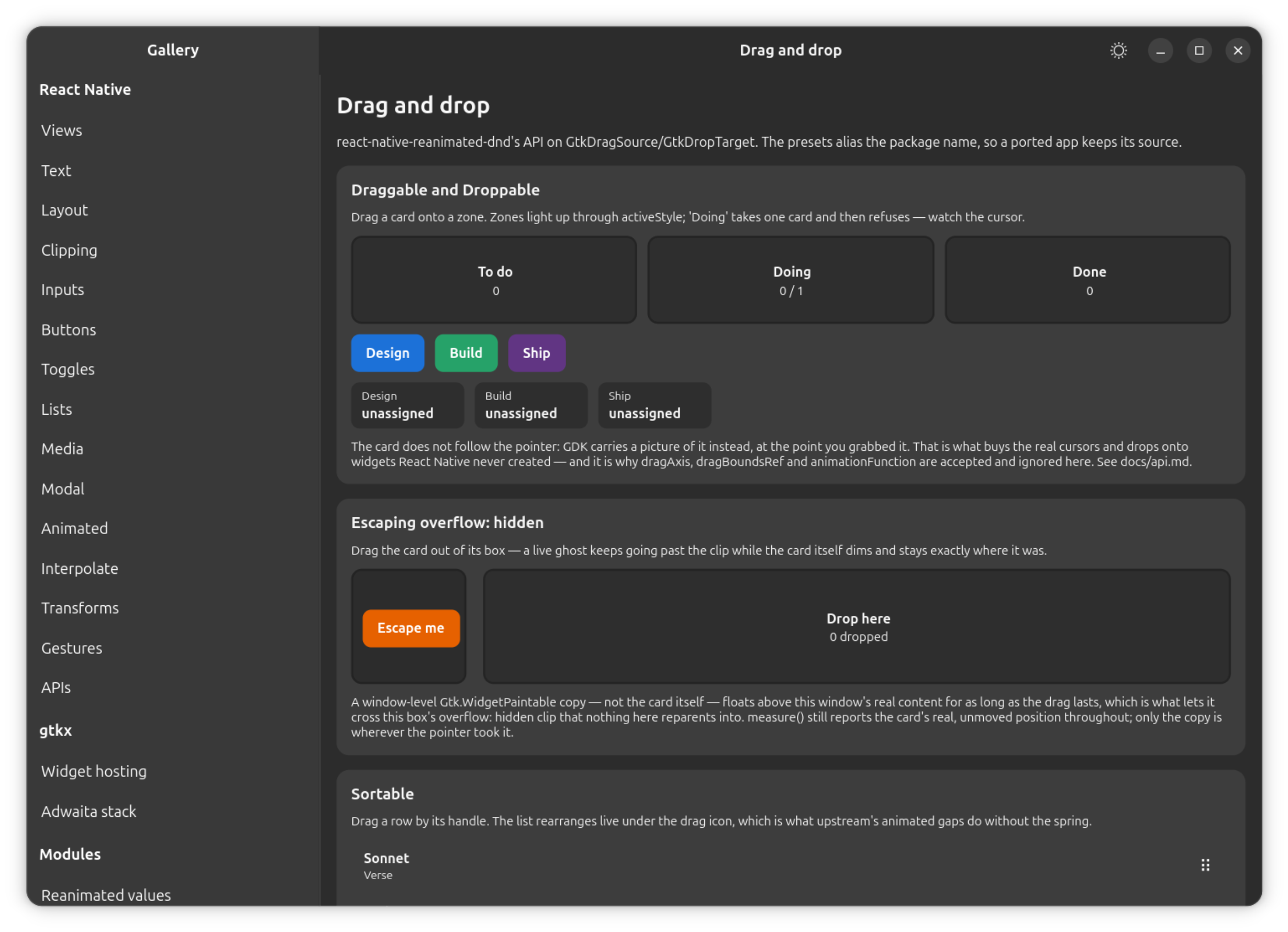
The dragged view never moves. GDK carries a Gtk.WidgetPaintable of it above
every window, with the theme's own cursors and hit-testing against the real
widget tree — including widgets React Native never created. Everything below
follows from that one fact.
The drag layer
A dragged Draggable/SortableItem escapes any overflow: hidden ancestor
automatically — not a prop, the same way GDK's own drag icon is not one.
GDK's icon already escapes any clip in this process's own tree (it is a
compositor surface, not a descendant of anything here), but that is only a
cue at the cursor this process cannot introspect. While a drag is in flight,
a second, non-interactive Gtk.Picture showing a live Gtk.WidgetPaintable
of the dragged row is added to a Gtk.Overlay wrapped once around each
window's real content, escaping every ancestor's clip the same way any
Overlay child does.
The original view dims to reduced opacity for the drag's duration — restored
to whatever it was, not hardcoded — rather than disappearing, the same
pattern react-native-draggable-flatlist's activeOpacity and similar
libraries use. Because a Gtk.WidgetPaintable is a live view of the widget
it observes, GDK's own drag icon and this overlay copy dim along with the
original — the three are one underlying render.
The dragged widget itself is never reparented into the overlay: a 100×100
card would render at 800×600 under a new parent's own size negotiation, and
an unmount mid-drag would strand the widget outside the tree React still
owns. The overlay copy takes no input (can-target: false); neither
hit-testing nor the responder path changes, both still resolve against the
original widget unchanged. See Gestures for the
responder path itself.
Zero React renders happen per frame: positioning the overlay copy is two
widget property writes (setMarginStart/setMarginTop) per motion event,
about 1.76 µs median.
Prop-by-prop
preDragDelay— Accepted, ignored. GDK'sgtk-dnd-drag-thresholdalready separates a tap from a drag.collisionAlgorithm— Accepted, ignored. GDK hit-tests the pointer directly;"center"is the closest of the three algorithms to that.requestPositionUpdate()— A no-op. Nothing caches a slot rectangle, because GDK re-hit-tests every motion event.onLayoutUpdateComplete— Accepted, ignored — there is no layout pass to complete.itemHeight,estimatedItemHeight,enableDynamicHeights,useFlatList,containerHeight,containerWidth— Accepted, ignored. Yoga lays rows out at their natural height, and the mirror's ownScrollViewmeasures its own viewport for autoscroll rather than trusting a hint.dragAxis,dragBoundsRef,animationFunction— Unsupported. All three describe where the dragged view goes, and it never goes anywhere here. Kept in the type so a file shared with iOS and Android still compiles.dropAlignment,dropOffset— Unsupported, same reason.positions,lowerBound/leftBound,autoScrollDirection/autoScrollHorizontalDirection,itemHeights— Real{ value }boxes (SharedValueLike), notSharedValue. Forwarding them with{...rest}works, reads work;autoScrollDirection/autoScrollHorizontalDirectionare genuinely written by the built-in autoscroll (below), the rest do not animate.SortableDirection.Horizontal,useHorizontalSortable,useHorizontalSortableList— Implemented. Reorder-by-crossing does not care which axis a list scrolls along — the tracked position reads whichever coordinate the axis cares about — so this isSortable/useSortable's own machinery with a horizontalScrollViewandleftBound/autoScrollHorizontalDirectionplumbing, not a second implementation.gap/paddingHorizontalare real Yoga layout on the content container, not hints.SortableGrid,SortableGridItem,useGridSortable,useGridSortableList— Implemented. The grid is a real YogaflexWraplayout — fixed-size cells, a fixed cross-axis dimension (columns/rows×itemWidth/itemHeight) — rather than upstream's absolutely-positioned cells at auseAnimatedStyle-computedtop/left; the same row/column arithmetic (calculateGridPosition) places them, a different engine paints it.getGridCellFromCoordinatesfloors onto the cell whose top-left corner is at or before a point, exactly matching upstream.SortableGridItem'sisBeingRemovedremoval animation is accepted and ignored, same reason asanimationFunctionabove.scrollEnabledis accepted and ignored too — this platform'sScrollViewhas no prop to disable input the way upstream's does.- Autoscroll near a container edge during a drag — Implemented for
SortableandSortableGrid: aGtkDropControllerMotionon the list's own viewport reports how close the drag sits to an edge, and aGtk.Widgettick callback nudges the realGtkAdjustmenttoward it for as long as it stays there — an imperative per-frame write, no React render either way. One difference from upstream: the scroll runs at a constant speed while the edge band is occupied, rather than easing into a 1500ms glide, because there is no timing engine here to ease with. Not wired into the standaloneuseSortableList/useHorizontalSortableList/useGridSortableListhooks, which build noScrollViewof their own to drive. - Sortable list height — Rows are in flow layout, so the list is as
tall as its rows, not
itemsCount × itemHeight.
Reorder feel: how a crossing resolves
Sortable/SortableGrid track the dragged item's own rect the same way
upstream does — fromIndex * slotSize plus the pointer's delta since the
drag began, reusing the same GtkDropControllerMotion the edge-autoscroll
above already watches every motion event with.
Differs from react-native-reanimated-dnd: this mirror resolves which slot the item has landed on by rounding that tracked position rather than flooring it — the dragged item's center against a slot's center, not its top-left corner against the slot's origin — symmetrically in both directions. Measured with a real pointer, a 100px row or cell needs about 50–60px of travel either way — away from index 0 or toward it, a center grab or an edge grab — before the crossing resolves.
The real, unaliased react-native-reanimated-dnd package's own arithmetic
floors the dragged rect onto a slot boundary from its top-left corner
instead: crossing a neighbor toward index 0 takes about one pixel of
travel there, crossing one away from it takes the neighbor's entire size in
that axis. That asymmetry is upstream's own behavior, reproduced unchanged
when an app opts out of the mirror and runs the real package — not a
compat-surface distortion this platform introduces.
The origin the tracking measures against is the drag's own grab point,
converted to the list's container coordinates — never the first motion
sample after a drag begins, since under fast pointer motion that sample can
already be displaced past GDK's own drag-start threshold, which would
silently undercount every reading taken from it. The change is scoped to
Sortable/SortableGrid's own reorder mechanism; Draggable/Droppable's
drop-zone hit-testing is untouched and still GDK's own — collisionAlgorithm
stays accepted-and-ignored there, as above.
Per-motion-event cost of the tracking arithmetic itself is about 0.003 µs median (settling from about 0.01 µs on the first JIT round) — pure arithmetic, no FFI hop — next to the drag layer's own roughly 1.76 µs for its two real GTK property writes per motion event.